Mr Sully Unfolds PhysicsAQA GCSE PHYSICS
AQA 4.2 · Paper 1

Electricity: AQA GCSE Physics revision

Electricity is topic 4.2 of AQA GCSE Physics (8463) and is assessed on Paper 1. This page has 21 key ideas grouped by specification section, the 7 equations you need, a revision checklist, common misconceptions and 44 key word definitions.

Mr Sully
Mr Sully says

Current is the flow, potential difference is the push, resistance is what gets in the way. Most marks here are V = IR and knowing your series and parallel rules cold.

Electricity key ideas

Everything the AQA specification expects you to know for this topic, grouped by spec section. Physics only isn't in Combined Science: Trilogy; Higher is Higher tier only.

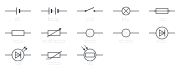
Circuit symbols. The diode and LED are drawn inside a circle; LED arrows point out (it gives out light), LDR arrows point in (light falls on it).

4.2.1 Circuits and charge

  1. Circuit diagrams use standard symbols, including cell, battery, switch, lamp, fuse, resistor, variable resistor, ammeter, voltmeter, diode, LED, thermistor and LDR.
  2. For electrical charge to flow through a closed circuit, the circuit must include a source of potential difference.
  3. Electric current is a flow of electrical charge. The size of the current is the rate of flow of charge: Q = It.
  4. The current is the same at any point in a single closed loop.

4.2.1 Current, resistance and p.d.

  1. V = IR. The greater the resistance of a component, the smaller the current for a given potential difference across it.

4.2.1 Resistors

  1. An ohmic conductor at constant temperature: current is directly proportional to potential difference, so resistance stays constant.
  2. Filament lamp: as the current increases, the temperature of the filament increases, so the resistance increases.
  3. Diode: current flows in one direction only. It has a very high resistance in the reverse direction.
  4. Thermistor: resistance decreases as temperature increases (used in thermostats). LDR: resistance decreases as light intensity increases (used in automatic night lights).

4.2.2 Series and parallel

  1. Series: the same current flows through each component; the total p.d. of the supply is shared; total resistance R = R₁ + R₂.
  2. Parallel: the p.d. across each branch is the same; the total current is the sum of the currents through the separate branches; the total resistance is less than the resistance of the smallest individual resistor.
  3. Adding resistors in series increases the total resistance. Adding resistors in parallel decreases it, because charge has more paths to flow through.

4.2.3 Domestic uses and safety

  1. Cells and batteries supply direct current (d.c.). Mains electricity is an alternating current (a.c.) supply. In the UK it has a frequency of 50 Hz and is about 230 V.
  2. Three-core cable: live wire (brown) carries the alternating p.d. from the supply; neutral wire (blue) completes the circuit and is at, or close to, 0 V; earth wire (green and yellow stripes) is a safety wire that only carries a current if there is a fault.
  3. The live wire may be dangerous even when a switch in the mains circuit is open. Touching it makes a large p.d. across your body, so a current flows through you. Any connection between the live wire and earth can be dangerous.

4.2.4 Energy transfers

  1. Power: P = VI and P = I²R. The power of a circuit device depends on the p.d. across it and the current through it.
  2. Energy transferred: E = Pt and E = QV. The amount of energy an appliance transfers depends on how long it is switched on and its power.

4.2.4 The National Grid

  1. The National Grid is a system of cables and transformers linking power stations to consumers. Step-up transformers increase the p.d. for transmission, so the current is lower and less energy is wasted heating the cables. Step-down transformers decrease the p.d. for safe use in homes.

4.2.5 Static electricity

  1. When certain insulating materials are rubbed together, electrons are transferred. The material that gains electrons becomes negatively charged; the one that loses electrons becomes equally positively charged. Physics only
  2. Like charges repel and unlike charges attract. These are non-contact forces. Static charge can build up and cause sparking. Physics only
  3. A charged object creates an electric field around itself. The field is strongest close to the object. A second charged object in the field feels a force that gets stronger as the distance between them decreases. Physics only

Electricity equations

You get the Physics Equations Sheet in the exam, but you still need to choose the right equation, rearrange it and use the right units. See every GCSE Physics equation.

Q = I t
charge flow = current × time
Units: C, A, s
V = I R
potential difference = current × resistance
Units: V, A, Ω
P = V I
power = potential difference × current
Units: W, V, A
P = I² R
power = (current)² × resistance
Units: W, A, Ω
E = P t
energy transferred = power × time
Units: J, W, s
E = Q V
energy transferred = charge flow × potential difference
Units: J, C, V
Vp × Ip = Vs × Is
for a 100% efficient transformer
Units: V, A Higher

The big picture: how electricity fits together

1Charge, current and potential difference

Current is the rate of flow of charge (Q = It). In metal wires the charge carriers are electrons. A potential difference is needed to make charge flow around a closed circuit; without a source of p.d., there's no current.

2Resistance

Resistance tells you how much a component opposes current. V = IR: for a fixed p.d., doubling the resistance halves the current. In required practical 3, longer wires have more resistance, in proportion to their length.

3Ohmic and non-ohmic components

A resistor at constant temperature is ohmic: its I–V graph is a straight line through the origin. A filament lamp isn't: as it gets hotter its resistance rises, so the graph curves. A diode only conducts in one direction.

4Sensors: thermistors and LDRs

A thermistor's resistance falls as temperature rises; an LDR's resistance falls as light intensity rises. Because their resistance changes with conditions, they are used to sense temperature and light, for example in thermostats and automatic night lights.

5Series circuits

In series, there's only one path. The current is the same everywhere, the supply p.d. is shared between the components, and resistances add. If one component breaks, everything stops.

6Parallel circuits

In parallel, each branch gets the full supply p.d. and the branch currents add up to the total current. Adding another branch gives charge another path, so the total resistance goes down. This is why homes are wired in parallel: every appliance gets 230 V and can be switched on and off separately.

7Direct and alternating current

Direct current (d.c.) flows in one direction only, like the current from a cell or battery. Alternating current (a.c.) keeps changing direction. UK mains is a.c. at 50 Hz and about 230 V.

8Plugs, wires and safety

The live wire (brown) carries the alternating p.d.; the neutral (blue) is close to 0 V; the earth wire (green and yellow) only carries current if there's a fault. Touching the live wire is dangerous even with the switch off, because your body is at 0 V and a large p.d. drives a current through you.

9Power and energy in appliances

Power ratings tell you how fast an appliance transfers energy (P = VI or P = I²R). The energy transferred depends on the power and how long it's on (E = Pt), or on the charge and p.d. (E = QV). The I²R form explains why current heats wires.

10The National Grid

Power stations are linked to consumers by cables and transformers. Step-up transformers raise the p.d. so the current is lower; a lower current means less energy is wasted heating the cables, which makes the Grid efficient. Step-down transformers lower the p.d. to a safe level for homes.

11Static electricity Physics only

Rubbing two insulating materials transfers electrons from one to the other. One becomes negatively charged and the other equally positively charged. Charged objects attract or repel each other without touching, and a large build-up of charge can cause a spark.

12Electric fields Physics only

A charged object is surrounded by an electric field, strongest close to the object. Another charged object in the field feels a force, which gets stronger the closer they are. For an isolated charged sphere, the field lines point straight out (positive) or straight in (negative), like spokes.

Electricity revision checklist

Can you do all of these? Rate yourself red, amber or green in the interactive checklist and your progress is saved in your browser.

  • Draw and interpret circuit symbols
  • Use Q = It and V = IR
  • Describe the resistance practical
  • Describe the I–V characteristics practical
  • Explain I–V graphs for a resistor, filament lamp and diode
  • Explain how thermistors and LDRs behave
  • Calculate total resistance in series and explain it for parallel
  • Describe a three-core cable and why the live wire is dangerous
  • Use P = VI, P = I²R, E = Pt and E = QV
  • Explain how the National Grid reduces the energy wasted in the cables
  • Explain static charge and electric fields (Physics only)

Common electricity misconceptions

Mistakes that lose marks every year. Read the myth, then the fix.

Is it true that current gets used up as it goes round a circuit?

MythCurrent gets used up as it goes round a circuit.
ActuallyThe current is the same before and after a component in series. It's energy that gets transferred, not current.

Is it true that adding resistors in parallel increases the total resistance?

MythAdding resistors in parallel increases the total resistance.
ActuallyIt decreases it, because charge has more paths to take.

Is it true that voltage flows through a circuit?

MythVoltage flows through a circuit.
ActuallyCurrent flows through components. Potential difference is measured across them.

Electricity key words and definitions

Learn these in the wording AQA uses. Test yourself with the flashcards.

Current
A flow of electrical charge; its size is the rate of flow of electrical charge. Measured in amperes (A).
Potential difference
Energy transferred per unit charge. Measured in volts (V).
Resistance
How much a component opposes current. R = V ÷ I, measured in ohms (Ω).
Ohmic conductor
Current is directly proportional to p.d. at a constant temperature.
Diode
Lets current flow one way only. Very high resistance in reverse.
Thermistor
Resistance decreases as temperature increases.
LDR
Resistance decreases as light intensity increases.
Alternating current
Current that keeps changing direction. UK mains: 230 V, 50 Hz.
Earth wire
Green and yellow stripes. A safety wire to stop the appliance becoming live. It only carries a current if there is a fault.
Step-up transformer
Increases p.d. and decreases current for transmission in the National Grid.
Charge flow
Q = It, measured in coulombs (C).
Series circuit rules
Same current everywhere; the p.d. is shared; total R = R₁ + R₂.
Parallel circuit rules
Same p.d. across each branch; currents add; total R is less than the smallest resistor.
Direct current (d.c.)
Current that flows in one direction only, e.g. from a cell or battery.
Live wire
Brown. Carries the alternating p.d. (230 V) from the supply.
Neutral wire
Blue. Completes the circuit and is at or close to 0 V.
Fuse
Melts and breaks the circuit if the current gets too high.
National Grid
The system of cables and transformers linking power stations to homes and businesses.
Step-down transformer
Reduces the p.d. to a safer level for homes.
Static electricity
Charge built up on insulators when electrons are transferred by rubbing (Physics only).
Electric field
The region around a charged object where another charge feels a force (Physics only).
Ammeter
Measures current. Connected in series.
Voltmeter
Measures potential difference. Connected in parallel across a component.
Equation: charge flow
Q = I t (units: C, A, s)
Equation: potential difference
V = I R (units: V, A, Ω)
Equation: power
P = V I (units: W, V, A)
Equation: power
P = I² R (units: W, A, Ω)
Equation: energy transferred
E = P t (units: J, W, s)
Equation: energy transferred
E = Q V (units: J, C, V)
Equation: power in a 100% efficient transformer
Vp × Ip = Vs × Is (units: V, A) · Higher
Circuit symbol: LED
A diode symbol with two arrows pointing out: it emits light when current flows.
Potential difference in series
Shared between components; adds up to the supply p.d.
Current in parallel
Splits between branches; total current = sum of branch currents.
Resistance in parallel
Total is less than the smallest individual resistor.
Energy transferred (charge)
E = QV
Energy transferred (power)
E = Pt
Power equations
P = VI and P = I²R
Why the National Grid uses high p.d.
For the same power, a lower current means less energy wasted heating the cables.
Appliance power rating
The energy it transfers each second when it is working normally.
Earthed (static)
Connected to earth so charge can flow away safely (Physics only).
Like charges
Repel. Unlike charges attract (Physics only).
Non-ohmic components
Filament lamp, diode, thermistor, LDR: resistance isn't constant.
Ohmic resistor I–V graph
A straight line through the origin: resistance is constant at constant temperature.
Charge on an electron
Negative; electrons carry the current in metal wires.

Electricity in the real world

Unfamiliar context? Don't panic. Exam questions often wrap physics you know in a situation you've never seen. 1) Strip away the story. 2) Find the physics words: force, energy, current, wave… 3) Pick the idea or equation that fits. 4) Link your answer back to the context.

Charging an electric car

Many drivers charge their electric car overnight on a 7 kW home charger.

The physics: Energy transferred = power × time. Higher-power chargers transfer the same energy in less time, but need a bigger current and thicker cables.

Try this

Calculate the energy transferred by a 7 kW charger in 8 hours.

Show answer

E = Pt = 7000 × (8 × 3600) = 201 600 000 J (about 2.0 × 10⁸ J). Convert kW to W and hours to seconds first.

Why cooker cables are thick

An electric cooker draws a much bigger current than a phone charger, so its cable is much thicker.

The physics: A thicker wire has a lower resistance. Heating in a wire is P = I²R, so with a large current a low resistance is needed to stop the cable overheating.

Try this

Explain why high-current appliances need thicker cables.

Show answer

Thicker cables have lower resistance. With a large current, the heating effect (P = I²R) would be large in a thin cable and could melt the insulation or start a fire. Lower resistance means less heating.

Street lights that switch on at dusk

Street lights and garden lights switch on automatically when it gets dark.

The physics: An LDR's resistance increases as the light level falls. The circuit detects this change and switches on the lamp. Thermostats use a thermistor in the same way, but for temperature.

Try this

Name the sensor in an automatic street light and describe how its resistance changes at dusk.

Show answer

A light-dependent resistor (LDR). As it gets darker, its resistance increases, and this change is used to switch the lamp on.

Refuelling aircraft (Physics only)

When a plane is refuelled, the fuel tanker and the plane are connected to the ground with a cable first.

The physics: Fuel rubbing through the hose can transfer electrons, building up static charge. A spark could ignite fuel vapour. Earthing lets charge flow safely to the ground.

Try this

Explain why the aircraft is earthed before refuelling.

Show answer

Friction between the fuel and the pipe can cause a build-up of static charge. A spark could ignite the fuel vapour. Earthing lets the charge flow to the ground so it can't build up.

Electricity required practicals

Printable electricity resources

More: all worksheets · all knowledge organisers · revision booklets · practice mock papers

Electricity animations

Series and parallel circuits

The dots show charge flowing: faster dots mean a bigger current. Compare how bright the lamps are in series and in parallel.

I–V characteristics

Slide the p.d. or press Sweep to draw the graph. Learn these three shapes: they come up every year.

Test yourself on electricity

Reading isn't revising. Open the interactive Electricity topic to quiz yourself, flip the flashcards, blurt everything you remember against the clock and try the Grade 5+ and Grade 7+ questions.