 Mr Sully Unfolds Physics
Waves required practical
Aim: Make observations to identify suitable apparatus to measure the frequency, wavelength and speed of waves in a ripple tank and waves in a solid (a stretched string), and take appropriate measurements.
The set-up
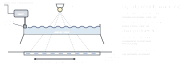
Method
- Ripple tank: shine a lamp through the tank to project the waves onto paper.
- Measure across several wavelengths with a ruler and divide to find one wavelength.
- Count the waves passing a point in 10 seconds and divide by 10 to get frequency.
- String: adjust the signal generator until you get a clear standing wave.
- Measure across several half-wavelengths to find the wavelength. Read the frequency off the generator.
- Calculate v = fλ.
Kit list
- Ripple tank
- Lamp and paper below
- Signal generator
- Vibration generator
- String, pulley and masses
- Metre rule
- Stopwatch
Stay safe
Mop up spilt water near the electrical equipment.
Masses can fall from the pulley. Keep feet clear.
What the examiner asks
- Suitability of apparatus: a metre rule (not a 30 cm ruler) to measure across many waves; a stopwatch over 10 s for frequency; a stroboscope or camera to freeze waves; the signal generator display for the string.
- Measuring several wavelengths and dividing reduces the uncertainty.
- A strobe or photo can freeze the ripples for measuring.
Going deeper
Key idea. Measuring across several waves (or several half-wavelength loops) and dividing reduces the uncertainty in a single wavelength.
Sample results
Sample results: vibrating string, constant tension
| Frequency (Hz) | Wavelength (m) | Wave speed (m/s) |
|---|---|---|
| 20 | 1.20 | 24 |
| 30 | 0.80 | 24 |
| 40 | 0.60 | 24 |
| 50 | 0.48 | 24 |
| 60 | 0.40 | 24 |
Analysing the results
- v = fλ for each frequency.
- The wave speed stays the same (24 m/s) for a fixed string and tension: speed depends on the medium, not the frequency.
- As frequency increases, wavelength decreases (inversely proportional).
- Plot λ against 1/f for a straight line; the gradient is the wave speed.
- Ripple tank: λ = distance across ten waves ÷ 10; f = waves passing a point in 10 s ÷ 10.
Errors and how to reduce them
- Random: waves move, so they're hard to measure. Use a stroboscope or take a photo with a ruler in shot.
- String: hard to see exactly where the nodes are. Measure across several loops (each loop = half a wavelength).
- Ripple tank: shallow water slows waves. Keep the water depth constant.
Accuracy, precision and resolution
- Measure over many wavelengths and divide, to reduce uncertainty.
- Count waves over a longer time (e.g. 10 s) for a more accurate frequency.
- Use the signal generator's frequency reading for the string experiment.
- Repeat and calculate means.
Model 6-mark method
Read it, cover it, then try writing your own.
Show the model answer
Set up a ripple tank with a lamp above and white paper below so the wave pattern is projected. Switch on the motor to produce plane waves. Place a metre ruler on the paper and measure the distance across ten wavelengths, then divide by ten to find the wavelength. Count the number of waves passing a point in 10 seconds and divide by 10 to find the frequency. Calculate the wave speed using v = fλ. Repeat several times and calculate a mean. Hazard: water and electrical equipment, so wipe up spills and keep the power supply away from the tank.
Grade 7–9 extras
- For the string: one loop is half a wavelength, so λ = 2 × length of one loop.
- Explain why the speed on the string stays constant while the frequency changes.
- Suggest a camera or stroboscope to 'freeze' the waves.
Common mistakes
- Measuring one wavelength only.
- Confusing a loop on the string with a whole wavelength.
- Forgetting to convert cm to m before calculating speed.
Practise the write-up
Write your method, results and evaluation in the app, then mark them against the criteria.