 Mr Sully Unfolds Physics
Light (reflection and refraction) required practical
Aim: Investigate the reflection of light by different types of surface and the refraction of light by different substances.
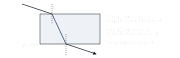
The set-up
Method
- Draw around the block and draw a normal at 90° to the surface.
- Shine a ray at the block along the normal at a measured angle of incidence.
- Mark the ray going in and out with crosses, then join them up.
- Measure the angles of refraction (or reflection) from the normal.
- Repeat for several angles and for other substances, e.g. glass, perspex and water in a clear plastic box.
- Reflection by different surfaces: shine the ray at a plane mirror, a shiny metal surface and a matt (rough) surface. Measure the angle of reflection and compare how bright and clear the reflected ray is.
- Smooth surfaces give specular reflection (angle of reflection = angle of incidence); rough surfaces scatter the light (diffuse reflection).
Kit list
- Ray box with a single slit
- Different surfaces to reflect from (mirror, shiny metal, matt paper)
- Clear plastic box of water
- Glass or perspex block
- Plane mirror
- Protractor
- Paper and pencil
Stay safe
The ray box gets hot. Work in a dim room and keep the walkways clear.
Keep the box of water away from the ray box and power supply; wipe up spills.
What the examiner asks
- Always measure angles from the normal, not the surface.
- A thin ray makes the angles more accurate.
Going deeper
Key idea. Angles are always measured from the normal, the line at 90° to the surface where the ray hits it.
Sample results
Sample results for a glass block
| Angle of incidence (°) | Angle of refraction (°) | Angle of reflection (°) |
|---|---|---|
| 10 | 7 | 10 |
| 20 | 13 | 20 |
| 30 | 19 | 30 |
| 40 | 25 | 40 |
| 50 | 31 | 50 |
| 60 | 35 | 60 |
Sample observations: reflection by different surfaces (angle of incidence 40°)
| Surface | Angle of reflection (°) | Reflected ray |
|---|---|---|
| Plane mirror | 40 | Bright, sharp: specular |
| Shiny metal | 40 | Bright, slightly blurred |
| White paper (matt) | No clear ray | Scattered: diffuse |
Analysing the results
- Reflection: the angle of reflection equals the angle of incidence.
- Refraction into glass: the angle of refraction is smaller than the angle of incidence: light changes direction towards the normal because it slows down.
- Plot angle of refraction against angle of incidence: a curve (not a straight line).
- A ray along the normal (0°) passes straight through without changing direction.
- Compare different materials: the material that changes the direction of the light more slows it down more.
Errors and how to reduce them
- Random: the ray is wide, so it's hard to mark its centre. Use a narrow slit to make a thin ray.
- Random: marking the ray with dots too close together. Mark two crosses far apart along each ray.
- Systematic: the block moves during the test. Draw around it so you can reposition it.
Accuracy, precision and resolution
- Resolution: a protractor reads to 1°; a larger protractor helps.
- Use a darkened room so the ray is easier to see.
- Repeat each angle and calculate a mean.
- Use a sharp pencil for thin lines.
Model 6-mark method
Read it, cover it, then try writing your own.
Show the model answer
Place a glass block on a piece of paper and draw around it. Draw a normal at 90° to one surface. Use a ray box with a narrow slit to shine a ray of light at the block where the normal meets the surface. Mark the incident ray and the ray leaving the block with crosses. Remove the block and join the crosses to show the path of the light through the block. Measure the angles of incidence and refraction from the normal with a protractor. Repeat for different angles of incidence and for different materials. Hazard: the ray box gets hot, so don't touch the bulb; work in a dimmed room carefully.
Grade 7–9 extras
- Explain refraction with wavefronts (Higher): one side of the wavefront slows first, so the wavefront changes direction.
- Explain that the ray leaving a parallel-sided block is parallel to the incoming ray.
- Some light is always reflected at the boundary: identify the weak reflected ray.
Common mistakes
- Measuring angles from the surface instead of the normal.
- Drawing rays freehand instead of with a ruler.
- Saying light 'bends'. It doesn't: it changes direction at the boundary because it changes speed.
Practise the write-up
Write your method, results and evaluation in the app, then mark them against the criteria.