 Mr Sully Unfolds Physics
Specific heat capacity required practical
Aim: Determine the specific heat capacity of one or more materials, such as aluminium and copper blocks, by linking the energy transferred by the heater (work done) to the increase in temperature and thermal energy stored.
The set-up
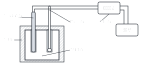
Method
- Measure the mass of the block on a balance.
- Wrap the block in insulation and put the heater and thermometer in the holes. A drop of water in the thermometer hole improves contact.
- Record the starting temperature.
- Switch on and record the energy (joulemeter, or E = VIt) and temperature every minute for 10 minutes.
- Plot temperature against energy transferred and draw a line of best fit.
- Calculate the gradient. c = 1 ÷ (gradient × mass).
- Repeat with a block made of a different material (e.g. copper or steel) and compare the values.
Kit list
- Metal block with two holes
- Immersion heater
- Thermometer
- Joulemeter (or ammeter, voltmeter and stopwatch)
- Balance
- Insulation
Stay safe
The heater gets hot. Don't touch it while it's on, and let it cool before packing away.
What the examiner asks
- The energy transferred electrically by the heater (work done) increases the thermal energy store of the block, raising its temperature.
- Why insulate? It reduces the energy transferred to the surroundings by heating.
- Your value is usually higher than the true value, because some energy heats the surroundings, not the block.
- Use the straight part of the graph: the block takes a while to warm up evenly.
Going deeper
Key idea. Controls matter: the same mass and the same insulation mean the only thing affecting the temperature rise is the energy supplied.
Sample results
Sample results for a 1.0 kg aluminium block (heater ≈ 50 W)
| Energy transferred (J) | Temperature (°C) |
|---|---|
| 0 | 20.0 |
| 3000 | 22.4 |
| 6000 | 25.6 |
| 9000 | 28.6 |
| 12 000 | 31.6 |
| 15 000 | 34.6 |
Analysing the results
- Plot temperature (y) against energy transferred (x) and draw a line of best fit through the straight section.
- The first reading lags: the block takes time to heat up evenly. Use the straight part only.
- Gradient = 9.0 °C ÷ 9000 J = 0.0010 °C/J.
- c = 1 ÷ (gradient × mass) = 1 ÷ (0.0010 × 1.0) = 1000 J/kg °C.
- Compare with the accepted value (900 J/kg °C): the experimental value is too high.
Errors and how to reduce them
- Systematic: energy is dissipated to the surroundings, so Δθ is smaller than it should be and c comes out too high. Reduce it with insulation and a lid/insulating base.
- Systematic: poor thermal contact between thermometer and block. Add a drop of water or oil to the thermometer hole.
- Random: reading the thermometer by eye. Use a digital thermometer and take readings at exact times.
Accuracy, precision and resolution
- Resolution: a digital thermometer reading to 0.1 °C is better than a 1 °C scale.
- Accuracy: the closer your value is to the accepted value, the more accurate it is.
- Repeatable: repeat with the same equipment and method; similar results = repeatable.
- A joulemeter measures energy directly and avoids the extra error from reading an ammeter, voltmeter and stopwatch.
Model 6-mark method
Read it, cover it, then try writing your own.
Show the model answer
Measure the mass of the aluminium block using a balance. Wrap the block in insulation. Place the immersion heater and the thermometer in the holes, adding a drop of water to the thermometer hole for good thermal contact. Connect the heater to a joulemeter (or to an ammeter, voltmeter and power supply) and record the starting temperature. Switch on and record the energy transferred and the temperature every minute for about 10 minutes. Plot a graph of temperature against energy transferred and draw a line of best fit. Calculate the specific heat capacity using c = 1 ÷ (gradient × mass), or c = ΔE ÷ (mΔθ). Hazard: the heater gets hot, so don't touch it and allow it to cool before removing it.
Grade 7–9 extras
- Explain the direction of the error: lost energy makes Δθ smaller, so c = ΔE ÷ (mΔθ) gets bigger.
- Explain why the graph doesn't start as a straight line (energy takes time to spread through the block).
- If using E = VIt, say the p.d. and current should be recorded regularly as they may change slightly.
Common mistakes
- Forgetting to convert mass to kg or time to seconds.
- Using the total temperature rise including the lag at the start.
- Saying 'heat is lost' instead of 'energy is dissipated to the surroundings'.
Practise the write-up
Write your method, results and evaluation in the app, then mark them against the criteria.